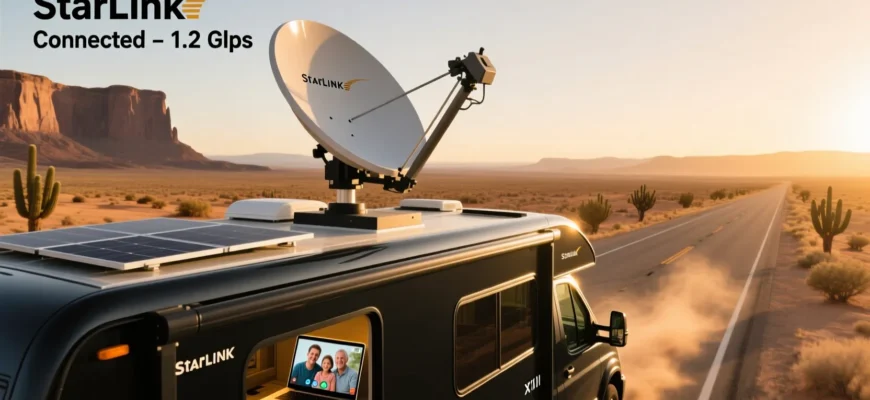
Navigating the Digital Road Ahead
For the modern RVer, the dream of ultimate freedom is often tethered to a single, frustrating reality: the quest for reliable internet service. The nomadic lifestyle, whether for work or leisure, increasingly demands a stable connection for remote jobs, route planning, staying in touch, or streaming a movie after a long day of driving. Traditional cellular networks have long been the default, but their reach is finite, creating vast “dead zones” where connectivity disappears. Into this gap, SpaceX’s Starlink has emerged as a revolutionary force, promising high-speed internet beamed directly from space.
The Promise of “Internet (Almost) Everywhere” for RVers
Starlink leverages a massive constellation of satellites in low-earth orbit (LEO) to deliver broadband connectivity to nearly any location with a clear view of the sky. As of October 2025, SpaceX has successfully deployed over 10,000 Starlink satellites, with approximately 8,795 currently operational in orbit. For RVers, this promise is transformative. It suggests the ability to work a demanding remote job from a secluded national forest, stream high-definition video from a desert boondocking spot, or hold a clear video call with family from a remote coastal pull-off—all places where traditional cell towers simply do not exist.
This satellite internet solution aims to sever the final cord tying nomads to populated areas, offering Starlink Internet speeds that rival traditional home broadband when conditions are optimal.
Setting Expectations: A Balanced Look Beyond the Hype
While the technology is undeniably groundbreaking, the practical application for RV life is not without its challenges. The question isn’t just “Does it work?” but “Does it work for my RV lifestyle?” Factors like significant power consumption, the absolute need for an unobstructed sky, and the nuances of data prioritization in crowded areas can turn the dream into a logistical puzzle. Starlink is a powerful tool, but it is not a universally perfect solution for every traveler.
Understanding Starlink: How Satellite Internet for RVers Works
At its core, Starlink is a satellite internet system, but it represents a monumental leap forward from the slow, high-latency services of the past. By fundamentally redesigning how data travels from space to your device, it offers an experience more akin to terrestrial broadband than traditional satellite.
Beyond Traditional Satellite: The Power of Low-Earth Orbit (LEO) Satellites
Starlink’s Low-Earth Orbit (LEO) satellites are significantly closer to Earth than traditional satellites, drastically reducing signal travel time (latency) for a faster connection.
Legacy satellite internet relies on a few large satellites in geostationary orbit, approximately 22,000 miles above the Earth. The immense distance this signal must travel results in high latency (lag), making activities like video conferencing or online gaming nearly impossible. Starlink’s innovation is its use of thousands of smaller satellites in a dense low-earth orbit satellite constellation, orbiting at approximately 550 kilometers (340 miles) above Earth. This drastically shorter distance is the key to its low latency and high speeds, as the data has a much shorter round trip to make.
According to CNET, Starlink latency ranges between 25-60 milliseconds, compared to 450-700 milliseconds for geostationary satellite systems. These LEO satellites are constantly moving, handing off the signal between one another to maintain a continuous connection for users on the ground. These satellites also connect to ground stations positioned across the globe, which link the Starlink service to the global fiber optic internet backbone, ensuring seamless data flow from space to your devices.
Key Components: The Starlink Dish, Router, and Ground Stations
The user-facing part of the Starlink service is deceptively simple. The Starlink Kit includes a satellite dish (affectionately nicknamed “Dishy”), a base, a Wi-Fi router, and the necessary cables. The satellite dish automatically orients itself to find and track the overhead satellites, receiving the signal and passing it through a proprietary cable to the Starlink Router inside your RV, which then creates a local wireless network for your devices to connect to. This entire system communicates with both the satellites and the network of ground transceivers connected to the global internet backbone.
The Starlink Router comes with Wi-Fi 6 capabilities in the Gen 3 model, providing robust connectivity across your RV, and can support third-party routers for users with specific networking needs.
The Evolution: From Original Dishy to Starlink Gen 3 and Mini
Starlink hardware is continuously evolving. The original circular dish has been replaced by more compact, rectangular models in the Standard Starlink Kit. The newer Starlink Gen 3 dish offers a sleeker profile and improved performance. For ultimate portability, the Starlink Mini, a device roughly the size of a laptop, integrates the router directly into the Mini Dish and is designed for maximum mobility. Each generation aims to improve efficiency, ease of use, and portability, offering different form factors to suit various travel styles.
Performance Specifications by Model (2025):
| Feature | Starlink Mini | Standard Gen 3 | Performance Gen 3 |
|---|---|---|---|
| Download Speeds | 100+ Mbps | 25-220 Mbps | 400+ Mbps |
| Upload Speeds | 5-20 Mbps | 5-20 Mbps | 8-25+ Mbps |
| Power Consumption | 20-40W (avg) | 50-75W (avg) | 75-100W (avg) |
| Field of View | 110° | 110° | 140° |
| Environmental Rating | IP67 | IP67 | IP69K/IP68 |
Starlink Plans for RVers: Choosing the Right Connectivity
Navigating Starlink’s service plans is crucial for RVers, as the right choice directly impacts performance, cost, and geographic flexibility. The plans are tailored for different use cases, with specific options designed for users on the move.
Starlink Roam Unlimited: Flexible, On-Demand Connectivity
The flagship plan for nomadic users is Starlink Roam, now offering the Roam Unlimited tier priced at $165/month USD (formerly Mobile Regional). This plan allows you to use your Starlink service at any location on the same continent where Starlink service has active coverage. A key feature for seasonal or part-time RVers is the ability to pause and un-pause the service on a monthly basis, providing significant cost savings during periods when you’re not traveling. This flexibility is a major advantage over traditional fixed internet service contracts.
As of 2025, Roam plans now include in-motion support up to 100 MPH, allowing RVers to stay connected while driving down the highway—a significant improvement over previous limitations.
Roam 50GB: Budget-Friendly Mobile Internet
For users who don’t need unlimited data, Starlink’s Roam – 50GB plan offers mobile internet at just $50/month USD. This plan, which can now be paired with any Starlink hardware (not just the Mini), includes all new Roam capabilities, including in-motion usage and global coverage. When you exhaust your 50GB monthly allotment, you can opt-in for additional data at $1/GB. This makes it an excellent option for light users or travelers who need periodic connectivity.
Understanding Data Prioritization for Mobile Users
A critical concept to grasp is data prioritization. Starlink’s network gives precedence to stationary, residential users. Starlink Roam users receive “best effort” service, meaning their data is deprioritized compared to residential customers. In uncongested, remote areas, this difference is often unnoticeable. However, in populated areas like cities or crowded campgrounds during peak hours, Roam users may experience slower download speeds as the network allocates broadband service bandwidth to higher-priority users first.
Priority Data Plans: For When Consistent Performance is Critical
For remote workers or users who cannot afford performance degradation, Starlink offers Priority Data plans (formerly called Mobile Priority). These higher-tier service tiers give your data priority over both residential and standard Roam users. The base-level Global Priority plan starts at $250/month for 50GB, with additional data available at $100 per 50GB increments or larger blocks at $1/GB. Additional tiers include 500GB for $650/month, 1TB for $1,150/month, and 2TB for $2,150/month. These are designed for critical applications and remote professionals who rely on stable, high-speed internet for their livelihood.
Global Roam: Taking Your Internet Adventures Across Borders
For the truly adventurous who travel across continents, Global Roam plans provide the same “best effort” internet service but with worldwide portability. This plan allows users to connect in any country where Starlink service is officially available, making it an option for international overlanders and world travelers. As of 2025, Starlink is available in over 100 countries, with growing coverage in Africa, Asia, and South America.
In-Motion Usage: Staying Connected While Traveling
A major 2025 update: all Roam plans now officially support in-motion use at speeds up to 100 MPH on land. This means you can work, stream, or communicate while your RV is actively driving down the highway—a game-changer for full-time nomads and remote workers who don’t want to wait until the next campsite to use their satellite internet.
The RV Advantage: Where Starlink Shines Brightest
For many RVers, Starlink is not just an improvement; it’s a complete game-changer that redefines what is possible on the road. Its core strengths directly address the most significant connectivity pain points faced by modern nomads.
Unparalleled Connectivity in Remote Areas: True Freedom for Boondockers
This is Starlink’s primary advantage. It delivers high-speed internet in places where cellular networks simply do not exist. For boondockers who cherish solitude in national forests, BLM land, or remote coastal areas, Starlink provides a reliable link to the outside world. This capability unlocks countless campsites that were previously off-limits for anyone needing to stay connected for work or safety. Where 4G LTE signals fade to nothing, Starlink Internet remains operational, providing true liberation for off-grid adventurers.
Reliable Speeds and Low Latency for Work and Play on the Road
When conditions are right, Starlink’s performance rivals that of a home broadband service connection. The combination of high internet speeds and low latency makes it more than capable of handling demanding tasks. This includes smooth, uninterrupted video calls on Zoom or Teams, uploading large files, streaming 4K movies, and even competitive online gaming—activities that were previously unthinkable with traditional satellite or spotty cellular networks. Download speeds typically range from 50-220 Mbps on Standard systems and up to 400+ Mbps on Performance hardware, making it suitable for professional work requirements.
Ease of Setup and Portability: Get Online Anywhere You Park
The Starlink Kit is designed for user-friendly, rapid deployment. Setting it up is as simple as placing the satellite dish on its stand in a location with a clear view of the sky, plugging in the power supply, and connecting to the Wi-Fi 5 or Wi-Fi 6 network. The Starlink app guides you through the process, and the dish automatically aligns itself. From unboxing to being online, the process can take as little as 15 minutes, making it incredibly convenient for frequent movers.
Freedom from Cell Towers: Bridging the Gaps in Cellular Networks
Even RVers with robust cellular networks setups encounter dead zones. Mountain ranges, dense forests, and sheer distance from civilization can render cell boosters and traditional antennas useless. Starlink operates independently of this terrestrial infrastructure. It provides a crucial layer of redundancy, ensuring that you can get online even when every bar on your phone has disappeared. This creates a safety net and a reliable backup, ensuring connectivity is always an option.
The RV Reality Check: Common Challenges and Considerations
While Starlink offers incredible benefits, integrating it into an RV lifestyle requires careful planning and a realistic understanding of its limitations. These challenges are not deal-breakers for most, but they must be managed.
Obstructions: The Persistent Enemy of Satellite Connectivity
Starlink requires a wide, clear view of the sky to maintain a stable connection with its fast-moving LEO satellites. Any obstruction—trees, buildings, or even a steep canyon wall—can cause intermittent signal drops. A few seconds of disconnection might be unnoticeable while browsing, but it’s enough to drop a video call or interrupt a file download.
The Starlink app includes an Obstruction Finder feature that helps you scan for obstructions before setting up. Using your phone’s camera, the app creates a comprehensive obstruction map of your location, showing exactly where trees and structures might interfere with your signal. This real-time visualization allows you to position your satellite dish in the optimal spot before deployment. However, camping in heavily wooded areas remains a significant challenge, and even trees on the horizon can impact signal quality.
Significant Power Consumption: A Major Hurdle for Off-Grid Living
This is arguably the most critical consideration for boondockers. Power consumption is substantial across all Starlink models:
-
Starlink Mini: 20-40W average (15W idle)
-
Standard Starlink: 50-75W average (20W idle)
-
Gen 3 Standard: 75-100W average (20W idle when optimized)
-
High Performance: 110-150W average (45W idle)
Running it 24/7 can drain an RV’s battery bank quickly without a robust power system. Off-grid users must have a substantial solar array, a large lithium battery bank, or a generator to sustain the system’s power consumption, especially on cloudy days. This demand often necessitates an expensive upgrade to an RV’s electrical system.
For boondocking with Starlink, a minimum setup typically includes:
-
400-600 watts of solar panels
-
400-600 Amp Hours (AH) of lithium battery capacity
-
A 3000W+ inverter for power management
For example, a Standard Starlink running 8 hours per day would consume approximately 400-600 Wh (0.4-0.6 kWh) daily—manageable with proper solar, but challenging without it. The Starlink Mini is more forgiving, requiring only 160-240 Wh for an 8-hour workday, making it ideal for smaller power systems.
The Cost of Connectivity: Hardware, Monthly Fees, and Hidden Expenses
Starlink is a premium internet service with a price tag to match. Current pricing (2025):
-
Starlink Mini Kit: $229 (on sale from $299)
-
Standard Kit: $279 (on sale from $349)
-
Roam Unlimited: $165/month
-
Roam 50GB: $50/month
-
Mobile Priority Data: $250-$2,150/month (depending on data tier)
When factoring in the potential need for power supply upgrades (lithium batteries at $1-3 per Wh, solar panels at $1-2 per watt, inverters at $1-3 per watt), the total cost of ownership can easily reach $5,000-$15,000 for a complete boondocking system. This substantial investment requires honest evaluation of your lifestyle and connectivity needs.
Physical Footprint and Mounting: Finding the Right Spot for Your Dish
The Starlink Dish and its associated cables need to be stored while traveling and deployed at each new campsite. While portable, the standard satellite dish is not small. Many RVers devise custom mounting solutions, such as flagpole mounts or roof mounts, to elevate the dish above ground-level obstructions and simplify setup. This often requires additional hardware and installation effort, though the Starlink app’s setup guidance makes it much easier for beginners.
Weather Sensitivity: While Resilient, Extreme Conditions Can Impact Performance
Starlink is designed to work in a variety of weather conditions, including rain, snow, and wind. The dish features a built-in heater for snow melting and can withstand extreme temperatures from -40°C to 60°C (-40°F to 140°F) and winds up to 170+ mph.
However, research shows that weather impacts Starlink performance:
-
Heavy Rain: Signal degradation due to rain fade is possible, though LEO satellites are more resilient than traditional geostationary satellite systems. In most cases, service returns to normal as the storm passes.
-
Snow: The built-in snow-melting heater can melt up to 40mm per hour (1.5 inches) on the Gen 2 Standard and 85mm per hour (3.5 inches) on Performance models. However, heavy snowstorms may accumulate faster than the dish can melt, requiring manual clearing.
-
Built-In Heater: This feature significantly increases power consumption during winter operation, potentially adding 20-30W during active snow melting.
Recent studies indicate that Starlink’s dynamic satellite switching provides better resilience to weather conditions compared to fixed geostationary satellite systems, but extreme conditions should still be anticipated in your power planning.
Data Caps and Deprioritization: Managing Expectations in Congested Areas
As mentioned, the standard Starlink Roam plan is subject to deprioritization. While there is currently no hard data cap on usage, in a busy campground where many users are on the network, internet speeds can slow down considerably during peak evening hours. Users must temper their expectations and understand that performance is not guaranteed to be at its peak in every location at all times.
The new Roam plans provide more transparency: if you exceed your data in a month, you’re limited to 1 Mbps download and 0.5 Mbps upload speeds until your next billing cycle, giving you a clear understanding of limits.
Customer Support and Response Times
Starlink’s customer support is handled primarily through a ticketing system within the app or website. There is no direct phone line for immediate assistance. Response times vary significantly:
-
Average response: 2-24 hours
-
Typical range: A few hours to several days
-
Reported delays: Some users report waits of up to 3 weeks during peak periods
While many issues can be resolved through the ticketing system, this lack of immediate phone support can be frustrating when dealing with critical connectivity issues on the road. The company has introduced an AI-driven support line chatbot that addresses common issues effectively, though complex problems may still require manual support.
Deep Dive into Starlink Hardware for RVers
Understanding the physical components of the Starlink system is key to planning its integration into your RV setup. The hardware is designed for simplicity but requires thoughtful placement and management.
The Standard Starlink Kit: Dish, Router, Power Supply, and Cables
When you order Starlink, you receive a single box containing everything needed to get online. The Standard Kit includes the rectangular satellite dish itself, a four-legged base for ground placement, a dedicated Starlink Router, a proprietary cable to connect the dish to the router, and an AC power supply for the router. The router acts as the system’s power supply, sending power over the Starlink cable to the dish, simplifying the overall setup. The long cable (75+ feet) provides flexibility in placing the dish far from the RV to find a clear view of the sky.
The Starlink Mini: Maximum Portability
The Starlink Mini represents the ultimate in portability. This compact device integrates the router directly into the Mini Dish, reducing the number of components and cables to manage. At just 25-40W power consumption, it’s ideal for RVers with limited battery backup capacity or those prioritizing lightweight travel. Download speeds reach 100+ Mbps, sufficient for most remote work and streaming applications.
Power Considerations: DC Power Input and Inverter Requirements
Most Starlink systems require AC power via a standard wall outlet or power supply. However, RVers can connect a DC power input system using a quality inverter (converting 12V or 48V DC to 110/240V AC). This integration is critical for boondockers relying on solar and battery backup systems.
Key power specs:
-
Mini: Requires USB Power Delivery (100W at 20V/5A recommended)
-
Standard: Requires AC power or compatible DC power via inverter
-
Gen 3 Performance: Supports both AC input and DC input for maximum flexibility
For serious off-grid setups, a hybrid system combining solar panels, lithium battery backup, and a quality power station like the EcoFlow DELTA 3 Pro ensures continuous operation even during low-sun periods.
Regulatory and Service Coverage Considerations
Starlink availability varies significantly by region. As of November 2025:
-
Coverage: 100+ countries
-
United States: Widespread availability, with some areas “sold out”
-
Canada: Full coverage available
-
Europe: Extensive coverage with ongoing expansion
-
Africa and South America: Expanding rapidly; some areas pending regulatory approval
For international travelers, the Global Roam plan ensures connectivity across borders, though maritime and in-motion use outside specified regions may require the higher-tier Priority plans.
The Verdict: Is Starlink Right for Your RV Adventures?
So, is Starlink truly the best mobile internet for your RV adventures?
The answer is a resounding yes, but with critical caveats. For the RVer who prioritizes connectivity in the most remote locations—the dedicated boondocker, the remote worker exploring off-the-beaten-path destinations—Starlink is not just the best option; it’s often the only practical option. Its ability to deliver high-speed, low-latency internet where cellular signals disappear is nothing short of revolutionary. It fundamentally changes the map of where one can live, work, and play on the road.
However, this unparalleled freedom comes with non-negotiable requirements. Starlink is not a simple plug-and-play accessory for every RV. It is a demanding piece of technology that insists on two things: a clear, unobstructed view of the sky and a significant, steady supply of power. The reality for any prospective user is that Starlink’s performance is intrinsically linked to the robustness of their RV’s power system. Without adequate solar and battery capacity, its utility for off-grid living is severely limited.
Making Your Decision: A Two-Part Evaluation
Part 1: Assess Your Travel Style
-
Primarily staying in well-connected RV parks? A cellular plan or campground public wifi networks may be more cost-effective.
-
Heart set on true off-grid exploration? Starlink is the clear frontrunner for reliable connectivity.
-
Mix of both? Roam plans offer flexibility with pause/resume capabilities.
Part 2: Evaluate Your Power Setup
Before purchasing the Starlink Kit, conduct an honest audit of your battery bank, solar array, and inverter.
-
Existing system inadequate? Budget $5,000-$15,000 for upgrades (solar panels, lithium batteries, inverter, and installation).
-
System can handle 75-100W continuously? You’re ready to integrate Starlink.
-
Limited power capacity? Consider the Starlink Mini as a lower-power alternative.
Final Thoughts
By addressing the power equation first, you can ensure that Starlink will be the powerful, liberating tool it promises to be, truly unlocking the next frontier of your RV adventures. The investment is substantial, but for those committed to off-grid exploration and reliable connectivity in remote locations, Starlink represents a fundamental shift in what RV travel can offer. The revolution in mobile internet is here—the only question is whether your power system and lifestyle are ready to embrace it.