Canada is the second-largest country in the world, spanning six time zones and boasting the longest coastline of any nation—over 202,000 kilometers of pristine water’s edge. Yet these statistics barely capture what makes camping in Canada a transformative experience. For millions annually, camping here transcends mere recreation; it’s embedded in the national identity, a rite of passage that connects visitors to landscapes of almost incomprehensible scale and beauty.
Whether you’re a first-time tent camper seeking your family’s next summer adventure, an RV traveler plotting a cross-country journey, a backcountry hiker testing your limits on remote trails, or a comfort-seeker exploring glamping alternatives, Canada offers camping experiences tailored to every skill level and preference. This guide bridges the gap between inspiration and execution—answering not just where to camp, but how to actually get there, what to expect, and how to do it safely within Canada’s unique ecosystem of public, private, and crown land.
From the iconic turquoise lakes of the Canadian Rockies in Alberta and British Columbia to the ancient boreal forests of Ontario, the rugged maritime coasts of Nova Scotia, and the midnight sun adventures of the Far North, this guide equips you with the knowledge to navigate Canada’s fragmented (but wonderfully diverse) camping infrastructure.
UNDERSTANDING CANADIAN CAMPGROUNDS: PUBLIC VS. PRIVATE
Before booking your first night, you need to understand the layered landscape of where you can actually camp in Canada. Unlike many countries with centralized national park systems, Canada’s camping ecosystem is deliberately decentralized—divided between federal, provincial, municipal, and private operators. This can confuse newcomers but creates extraordinary diversity and opportunity for those who understand the system.
National Parks (Parks Canada)
Parks Canada operates 48 national parks across the country, each designated as a “Crown Jewel” protecting landscapes of exceptional ecological or geological significance. These parks represent the apex of Canada’s conservation hierarchy and offer some of the world’s most stunning camping experiences.
Why National Parks Matter:
National park campgrounds are heavily regulated, ensuring infrastructure quality and environmental protection. You’ll find developed facilities including pit toilets or flush toilets, fire rings, picnic tables, and water access. Many sites now feature reservation systems managed through Parks Canada’s centralized booking platform (reservations.pc.gc.ca), which operates on a launch-day model—sites become available exactly 5 months in advance, and popular locations sell out within hours.
The Big Three (and Beyond):
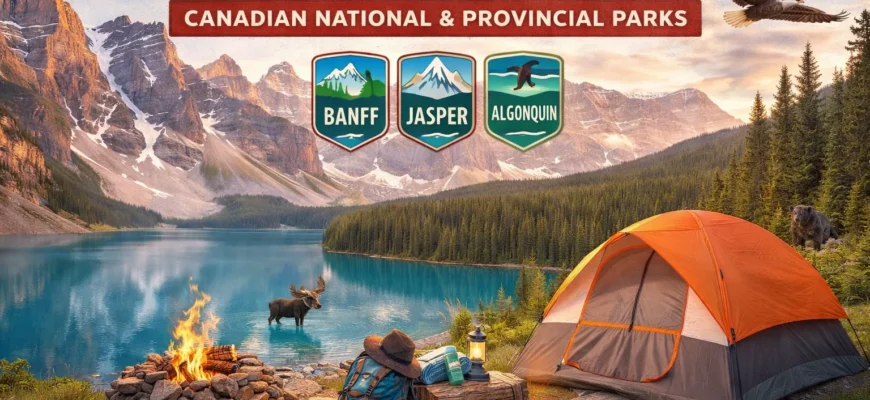
The Rocky Mountain parks—Banff, Jasper, and Yoho in Alberta and British Columbia—dominate visitor imagination. Banff National Park alone draws over 4 million visitors annually. Lake Louise, Moraine Lake, and the Icefields Parkway define the postcard image of Canadian camping. However, seasoned campers often bypass these crowded locations for equally stunning alternatives: Kluane National Park (Yukon) offers glaciers and grizzly bears with a fraction of the crowds, while Gros Morne (Newfoundland) provides fjord-side camping with minimal competition.
On the coastal front, Pacific Rim National Park Reserve (Vancouver Island) delivers temperate rainforests and wild beaches, while Cape Breton Highlands (Nova Scotia) offers dramatic maritime scenery along the Cabot Trail.
Internal Linking Opportunity: Later, develop a detailed cluster article: “Complete List of Parks Canada National Parks with Campground Details, Booking Tips & Seasonal Availability.”
Provincial Parks
Provincial parks represent the workhorse of Canadian camping. Run individually by each province’s parks authority (Ontario Parks, BC Parks, Quebec Parks, etc.), these parks are often underrated by international visitors but frequently offer superior value, accessibility, and availability compared to their national counterparts.
Why Provincial Parks Are Strategic:
Provincial parks typically cost 40-50% less than national parks ($20-35 CAD/night vs. $25-50+ for nationals), operate with more flexible reservation windows (booking opens 1-3 months in advance depending on province), and maintain comparable or superior facilities. Ontario Parks, for instance, manages over 140 provincial parks with camping, rivaling many countries’ entire national park systems.
Regional Standouts:
-
Ontario: Algonquin Provincial Park is the heavyweight champion for backcountry canoeing in North America. With over 2,000 backcountry campsites accessible only by canoe, it attracts paddlers globally. Pinery Provincial Park offers sandbar beach camping on Lake Huron; Bruce Peninsula provides limestone cliffs and turquoise water rivaling the Rockies but with far fewer crowds.
-
British Columbia: Strathcona Provincial Park in Vancouver Island’s wilderness and Wells Gray Provincial Park (with its glacier-fed lakes) deliver mountain scenery at provincial-park pricing.
-
Quebec: La Mauricie National Park (federally run but with provincial character) combines boreal forest and 150+ lakes; Mont-Tremblant Provincial Park offers hiking and lake access year-round.
The strategic advantage: provincial parks often require advance planning but reward early bookers with choice sites at lower costs.
Crown Land & Wild Camping
This is the frontier—and the most misunderstood camping category in Canada.
Crown land is publicly owned territory not designated as parks. In provinces like British Columbia, Ontario, and Quebec, enormous swaths of wilderness are technically open to dispersed camping under specific regulations. This is where you find “free camping,” “off-grid camping,” and backcountry experiences beyond established infrastructure.
Critical Distinction for Non-Residents:
For US citizens and international visitors, this is non-negotiable information: regulations differ dramatically between residents and non-residents. Many provinces restrict non-residents’ ability to camp on undesignated crown land or require specific permits. Non-residents are strongly encouraged to use designated provincial parks or hire outfitters familiar with local regulations. Violating these rules can result in fines ($200-500 CAD) and legal complications.
For Canadian Residents:
Crown land camping is often free or minimal-cost, governed by principles of “Leave No Trace” stewardship. British Columbia’s Crown Land camping guidelines permit vehicle-accessible camping in specific zones; Ontario’s crown land camping is regulated through specific forestry zones. Detailed provincial guides exist, but research is essential before departing.
Keyword Targeting: “Off-grid camping Canada,” “Free camping in British Columbia,” “Backcountry camping Ontario”—these searches reflect explorer intent and carry lower competition than “best camping Canada.”
Private Campgrounds & Glamping
When designated parks are booked (which they frequently are), private operators fill the gap—often with superior amenities and lower advance-booking pressures.
KOA (Kampgrounds of America):
KOA operates 45+ campgrounds across Canada, typically offering full hookups (electricity, water, sewage), Wi-Fi, pool access, and last-minute availability. Nightly rates range from $45-80 CAD depending on location and season. These sites appeal to RV travelers and families seeking predictable comfort.
Hipcamp & Airbnb Experiences:
Hipcamp pioneered the “glamping directory” model—connecting owners of private land with travelers seeking unique stays. This is where the competitive gap you identified becomes critical. Hipcamp excels at directory curation but provides limited educational context about what makes each experience unique or how it fits into Canada’s broader camping taxonomy. Your hub page establishes this authority—explaining why someone might choose a private cabin over a national park site (amenities, flexibility, no reservation lottery), thereby positioning cluster articles as decision-support resources Hipcamp doesn’t offer.
Boutique Glamping:
High-end options like oTENTiks (Parks Canada’s exclusive canvas cabins), yurt resorts in British Columbia, and geodesic domes throughout the country command premium pricing ($100-300+ CAD/night) but deliver “comfort camping” experiences—the tent experience without gear ownership or weather risk.
Monetization Angle: Private campground and glamping partnerships generate affiliate revenue (Hipcamp, Airbnb referrals, RV rental platforms like Outdoorsy and RVezy), while KOA and regional chains often support affiliate programs with competitive commission structures.
BEST PLACES TO CAMP IN CANADA (BY REGION)
Geographic segmentation is essential for both user navigation and SEO clustering. A visitor asking “Where should I camp in Canada?” has fundamentally different needs than someone searching “Best camping near Vancouver” or “Backcountry camping Ontario.” This section bridges inspirational intent with actionable geography.
Western Canada: British Columbia & Alberta
The West dominates international camping perception, anchored by mountains and ocean.
The Canadian Rockies: The Global Anchor
Banff and Jasper National Parks sit at the intersection of mythology and reality. Lake Louise, with its milk-blue glacier-fed waters reflecting the Valley of the Ten Peaks, appears on millions of Instagram feeds annually—and the hype is justified. But informed travelers know the strategy: visit in September when summer crowds dissipate, nights cool (requiring proper sleeping bags), and the landscape becomes yours.
Banff operates four major campgrounds: Lake Louise (210 sites, often booked within minutes of the launch date), Tunnel Mountain Village (1,100+ sites, your realistic option if you missed the lottery), Moraine Lake Campground (98 walk-in sites, first-come-first-served after 8 AM daily), and Rampart Creek (limited, backcountry-adjacent).
Jasper National Park offers similarly stunning but slightly less-crowded alternatives. The Icefields Parkway connecting these parks is itself a scenic campground—Honeymoon Lake, Sunwapta Falls, and Wilcox Pass Campgrounds offer roadside access to turquoise water and glaciers.
The Vancouver Island Trinity: Pacific Rim, Tofino, and Beyond
Pacific Rim National Park Reserve occupies the wild west coast of Vancouver Island—a temperate rainforest meeting the Pacific Ocean. Green Point Campground (94 sites) sits above Ucluelet beach; Schooner Cove provides backcountry canoeing. The park’s iconic attraction, the West Coast Trail (75 km backcountry hiking), permits only 60 hikers daily—indicating its preciousness.
Tofino, the village outside the park, has become a surf-culture hub. Nearby beaches and private campgrounds support the town’s growing reputation as a “California of Canada.”
Okanagan Valley: Wine Country Camping
British Columbia’s interior wine country (Kelowna, Penticton, Osoyoos) offers warm, dry summers—the sunniest region in Canada. While national parks dominate marketing, the Okanagan delivers underrated camping: beautiful lakes, nearby vineyards, and a laid-back culture. Okanagan Lake Provincial Park and Penticton’s nearby options combine beach access with wine-tasting logistics.
Monetization note: “Back Forty Vineyards” and similar agritourism experiences create affiliate opportunities through tourism boards and experience platforms.
Snippet Optimization: “Western Canadian camping best for turquoise alpine lakes, mountain vistas, and glacier-fed rivers. Peak season: July-August. Best time to avoid crowds: late August-early September.”
Central Canada: Ontario & Quebec
Central Canada’s camping reputation rests on water—thousands of lakes connected by canoe portages, creating North America’s premier paddling destination.
Ontario: The Canoe Headquarters
Algonquin Provincial Park, a 7,630 km² wilderness 2 hours north of Toronto, is to Canadian camping what Yosemite is to American wilderness. With over 2,000 backcountry campsites accessible only by canoe, Algonquin attracts international paddlers for its portage systems, crystal lakes, and moose sightings.
The park’s frontcountry campground (Mew Lake, 613 sites) serves car campers; most facilities are basic (pit toilets, water pumps) but sufficient. Backcountry camping requires canoe rental, trip planning, and advance reservations—not casual undertaking but life-altering for paddlers.
Bruce Peninsula National Park offers a dramatically different experience: limestone cliffs (the Niagara Escarpment), turquoise waters (freshwater rivals the Caribbean), and hiking trails along ancient geological formations. The park’s smaller size (156 km²) means better availability than Algonquin.
Pinery Provincial Park, often overlooked, delivers sandbar beach camping on Lake Huron with a small-town Ontario charm. Dune ecology and sunset viewing over water create intimate experiences.
Quebec: Boreal Beauty
La Mauricie National Park (launched 1970) combines boreal forest, glacial lakes, and canoe-in accessibility. With 150+ named lakes and 700+ km of trails, it rivals Algonquin for paddling prestige but receives a fraction of the crowds—a strategic discovery for informed travelers.
Mont-Tremblant Provincial Park, Quebec’s largest, offers year-round camping with alpine trails, river valleys, and Laurentian forest. Summer camping gives way to fall foliage (late September-October) and winter backcountry skiing.
Snippet Optimization: “Central Canadian camping best for lake paddling, boreal forest immersion, and multi-day canoe trips. Peak season: July-August. Best for solitude: June or September-October.”
Atlantic Canada: The Maritime Experience
Atlantic provinces offer coastal camping and maritime culture—a distinctly different Canadian experience.
Nova Scotia: The Cabot Trail
Cape Breton Highlands National Park wraps around the northern tip of Nova Scotia. The Cabot Trail (300 km scenic drive) circumnavigates the park with multiple viewpoint campgrounds. Ingonish Campground offers beachfront camping with ocean views; inland sites provide forest refuge.
Nova Scotia’s coastline delivers dramatic sea cliffs, white-sand beaches, and maritime heritage. September weather is optimal—warm days, cool nights, minimal bugs.
Newfoundland: The Fjord Experience
Gros Morne National Park, a UNESCO World Heritage site, showcases some of North America’s most dramatic landscapes. Ten Mile Pond and Lomond Campgrounds sit adjacent to fjords carved by Pleistocene glaciers. Western Brook Pond, a 16 km-long landlocked fjord, is accessible via 3 km hiking trail from the campground—a daily adventure from your campsite.
Newfoundland offers a rugged, less-commercialized experience than southern parks. Weather is variable (prepare for rain, even in summer), but the isolation appeals to photographers and adventurers.
Prince Edward Island: Beach Camping
PEI’s provincial parks offer beach-adjacent camping with red sandstone cliffs and warm ocean water (by Atlantic standards, 18-20°C in summer). Cavendish Beach Provincial Park provides dune camping with Anne of Green Gables heritage tourism nearby.
Snippet Optimization: “Atlantic Canadian camping best for coastal scenery, maritime culture, and seafood experiences. Peak season: August-September. Best for photographers: September (morning fog, dramatic light).”
The North: Yukon & Northwest Territories
For adventurous travelers seeking extremes, the Far North offers midnight sun camping and Aurora Borealis viewing.
Yukon: Kluane National Park
Kluane, home to Canada’s highest peak (Mount Logan) and largest non-polar ice fields, delivers wilderness camping with minimal crowds. The park operates Kathleen Lake Campground (41 sites) and backcountry options accessible via the Chilkoot Trail (historic gold-rush route).
Midnight sun camping (24-hour daylight June-July) creates surreal experiences—fishing at midnight, hiking under perpetual light. September brings aurora viewing potential and reduced tourism pressure.
Northwest Territories: Yellowknife Aurora
Yellowknife, the territorial capital, sits at 62° N latitude—prime Aurora Borealis viewing territory (September-March). While true “camping” gives way to lodge and cabin stays in winter, summer backpacking around Great Slave Lake and Hay River offers true northern wilderness.
Snippet Optimization: “Northern Canadian camping best for midnight sun experiences, aurora viewing, and extreme wilderness immersion. Peak season: June-July (midnight sun), September-March (aurora). Accessibility note: remote locations require vehicle or air access; planning essential.”
CAMPING STYLES: WHICH ONE SUITS YOU?
Intent segmentation is crucial for CRO. Different camping styles attract different monetization opportunities, internal linking strategies, and user decision journeys.
Frontcountry (Car Camping): The Gateway Experience
Definition: Drive directly to your campsite. Park your car meters away. Unload gear in minutes.
Frontcountry represents 80%+ of Canadian park camping—accessible, beginner-friendly, and social. Sites include fire rings, picnic tables, and water access; many feature electrical hookups.
Who It Serves:
Families with young children, first-time campers, busy professionals seeking weekend escapes, travelers with mobility considerations.
What to Expect:
-
Amenities vary: pit toilets (free parks) to flush toilets and showers (premium sites)
-
Nightly noise from neighboring sites (especially peak summer weekends)
-
Reservation competition (June-August = fully booked months in advance)
-
Social camping culture (campfire conversations with strangers)
Essential Gear Checklist (Affiliate Opportunity):
-
Tent (3-4 season rating for summer; 0-1 season for shoulder seasons)
-
Sleeping bag (-5°C to 0°C rating minimum for Canadian summers; colder for spring/fall)
-
Sleeping pad (insulation + comfort; critical for ground moisture)
-
Camp stove & fuel (fire bans affect 15-20% of sites during summer—backup heat/cooking essential)
-
Cooler (bear-proof essential; capacity 40-60L for 2-4 person trips)
-
Headlamp (dual-purpose lighting for safety and campsite navigation)
Monetization: Build deep affiliate content linking to REI, MEC (Mountain Equipment Co-op—Canada’s cooperative outdoor retailer), Amazon.ca, and regional outdoor retailers.
Backcountry: The Immersion Experience
Definition: Carry all gear on your back (hiking) or load it into a canoe (paddling). No vehicle access; no developed facilities.
Backcountry camping represents the authenticity pole—genuine wilderness immersion without infrastructure crutches.
Why Backcountry Matters:
Solitude, wildlife encounters, self-reliance, and landscapes untouched by development. A backcountry paddler in Algonquin might see moose, beaver, and loons daily while car campers 50 km away see only other tourists.
Technical Challenges:
-
Route planning and navigation (maps, compass, GPS)
-
Water purification or carrying systems (3-4L daily hydration needs)
-
Food storage (bear-proof canisters or hanging methods)
-
Weather navigation (no shelter except your tent)
-
Physical fitness (8-16 km daily hiking; 6-10 km daily paddling for multi-day trips)
Best Spots for Backcountry Initiation:
-
Algonquin Provincial Park (Ontario): 2,000+ sites, established portage system, guide availability
-
West Coast Trail (British Columbia): 75 km coastal hiking, 48-person daily limit, permit system ensures low crowding
-
Bowron Lake Circuit (British Columbia): 116 km canoe loop, complete circuit with established campsites
-
Rockwall Trail (Kootenay National Park, BC): 55 km alpine hiking with hut-style backcountry accommodations
Cluster Article Opportunity: “Backcountry Camping Guide: Route Planning, Water Purification, Bear Safety & 5-Day Trip Itineraries”
RV & Vanlife: The Mobile Experience
Definition: Travel in a self-contained vehicle (motorhome, travel trailer, converted van). Camp at serviced or unserviced sites.
RV camping has exploded post-pandemic, with supply chain challenges creating 1-2 year waiting lists for new units (as of 2025-2026). This demographic is growing rapidly and highly profitable (campground stays, fuel, services, gear upgrades).
Serviced vs. Unserviced Sites:
-
Serviced (Full Hookup): Electrical (30/50 amp), water connection, sewer hookup. Cost: $50-100+ CAD/night. Amenities: Wi-Fi, laundry, pool.
-
Unserviced: No connections; self-contained units have grey-water tanks, propane, and batteries. Cost: $20-40 CAD/night.
Critical Logistics:
-
Dump Stations: Free or paid facilities for waste disposal; concentrated near major cities and parks
-
Fuel Availability: Plan refueling in smaller towns (spacing can exceed 200 km in remote regions)
-
Vehicle Restrictions: Weight limits, height restrictions (many parks restrict vehicles over 8 meters), seasonal access (winter closures common)
Monetization Angle: Partner with RV rental platforms (Outdoorsy, RVezy), insurance providers, extended warranty companies, and gear suppliers (propane adapters, waste tank treatments, tires).
Glamping & Comfort Camping: The Luxury Experience
Definition: “Glamorous camping”—tent-based or semi-luxe accommodation with amenities reducing discomfort.
Glamping appeals to Instagram aesthetics, budget-conscious luxury seekers, and travelers uncomfortable with traditional camping roughness.
Parks Canada’s Innovation: oTENTiks
oTENTiks (canvas platforms resembling safari tents) represent Parks Canada’s response to under-served demand. These semi-permanent structures feature:
-
Raised canvas platform (no ground moisture)
-
Beds with mattresses (no sleeping bag necessity)
-
Heat source for cool nights
-
Covered porch
-
Cost: $75-110 CAD/night (premium vs. tent camping, budget vs. hotels)
Available in Banff, Jasper, Waterton, and Pacific Rim, oTENTiks book 4-5 months in advance—indicating strong demand.
Yurt & Geodesic Dome Resorts:
British Columbia’s interior and Muskoka region (Ontario) feature upscale glamping with:
-
360° window views
-
Heated interiors
-
En-suite bathrooms
-
Installed kitchens
-
Cost: $150-250 CAD/night
Monetization: Affiliate networks for glamping platforms (Glamping Hub, Airbnb Experiences) and travel insurance products.
PLANNING YOUR TRIP: LOGISTICS & RESERVATIONS
User research identifies “how to actually book” as a critical pain point. This section solves immediate, transactional friction.
The Reservation Ecosystem: Understanding Launch Day
Parks Canada Reservation Service (Reservations.pc.gc.ca)
Parks Canada operates a centralized, nationwide system governing all 48 national parks’ campgrounds. Here’s the tactical reality:
Launch Mechanics:
-
Reservations open exactly 5 months in advance (midnight, 8 AM ET)
-
Peak sites (Lake Louise, Moraine Lake, Banff, Jasper) sell out within 30-120 minutes
-
System crashes common (millions attempting simultaneous access)
-
Non-refundable reservation fee ($15-25 CAD)
Winning Strategies:
-
Create account 1 week early: Log in, verify payment method, confirm personal details before launch date
-
Target shoulder dates: July 10-20 or August 25-31 receive fewer bookings than mid-July/early August
-
Have backup parks ready: Develop 3-5 alternatives in different regions if your first choice sells out
-
Explore first-come-first-served sites: Many parks (Moraine Lake, Wilcox Pass, Honeymoon Lake) operate daily lottery systems after 8 AM—strategies exist to secure premium spots without pre-booking
-
Canoe backcountry sites: Often have higher availability; Algonquin and other paddling parks fill slower than car camping
Provincial Park Reservation Windows:
Provincial parks operate independent systems (Ontario Parks, BC Parks, Alberta Parks, etc.) with staggered opening dates:
-
Ontario Parks: Opens 4-5 months in advance; popular sites book 8 weeks out
-
BC Parks: Opens 3 months advance; less crowded than Parks Canada
-
Alberta Parks: Opens 3 months advance
-
Quebec Parks: Opens 2-3 months in advance; often available through fall
Strategic Insight: Provincial parks represent underutilized opportunities. While tourists obsess over national park launch dates, provincial park inventory remains available—often with superior value and less crowd pressure.
If Everything Is Booked: Cancellation & Waitlist Strategies
Parks Canada and provincial parks permit free cancellation up to 1 week before arrival—creating nightly cancellation inventory. Monitoring tools exist (third-party apps scrape reservation systems) to alert users to opening slots. Dedicated campers refresh reservation sites daily during their desired week, catching cancellations in real-time.
Waitlists: Parks Canada permits reservation holds; provincial systems vary. First-come-first-served sites (managed by on-site staff) operate daily—arrive before 8 AM, register as backup, secure your spot if no reservations appear.
Best Time to Camp: Seasonality & Weather
Canadian camping seasonality is pronounced—not optional consideration.
Peak Season (July-August):
-
Weather: Warmest temperatures (20-25°C daytime; 10-15°C nights), minimal precipitation
-
Wildlife: Most active (bears, moose, birds); bear encounters peak
-
Crowds: Maximum; parks operate at 95-100% capacity; noise and social pressure high
-
Cost: Premium pricing; peak reservation competition
-
Best for: Families, beginner campers, warm-weather seekers; RV travelers
Shoulder Season (May-June & September-October):
-
Weather: Highly variable; September warmer than June; both risk cold nights (sleeping bags essential)
-
Wildlife: Less active but more easily observed (bears less aggressive; moose rut September-October offers viewing opportunities)
-
Crowds: Dramatically lower; many sites available walk-in
-
Cost: 30-40% discount vs. peak season
-
Bugs: June peak for black flies (Alberta, Ontario interior); September near-zero
-
Best for: Photography, solitude-seekers, experienced campers, photographers
Winter Camping (November-April):
-
Temperature: -10°C to -30°C; extreme cold; requires 0-season sleeping bag (-30°C rated minimum), insulated sleeping pad, winter-specific techniques
-
Snow: 30-300 cm depending on region; adds difficulty; requires snowshoes/skis
-
Light: Short days (5-6 hours sunlight in December); 24-hour darkness near Artic; aurora viewing prime season in north
-
Crowds: Virtually zero
-
Cost: Minimal
-
Best for: Experienced mountaineers, aurora photographers, extreme adventurers only
Optimal Timing Analysis:
August delivers warmest, most reliable weather but worst crowds. September offers best crowd-to-weather ratio: warm days (15-20°C), cool nights, minimal bugs, dramatic light, aurora potential (late month). Early fall foliage peaks late August-September in eastern Canada.
Costs & Budget: The Transparency Question
User searches for “How much does camping cost in Canada?” signal price-sensitivity. Transparent pricing builds trust.
Official Park Camping:
-
National Parks (Parks Canada): $25-50 CAD/night depending on amenities and park
-
Unserviced (pit toilet, no water): $20-30
-
Semi-serviced (water access, flush toilets): $30-40
-
Serviced (electricity, water): $40-50
-
OTENTiks (glamping): $75-110
-
Backcountry (per-night fee): $10-15
-
-
Provincial Parks: $15-40 CAD/night (average 20-30% cheaper than national parks)
-
Budget campgrounds: $15-25
-
Premium waterfront: $35-45
-
Glamping/cabins: $60-150
-
-
Private RV Campgrounds (KOA, etc.): $45-85 CAD/night
-
Basic unserviced: $35-50
-
Full hookup: $60-100
-
-
Glamping Resorts (yurts, domes, tents): $100-300+ CAD/night
Cost-Benefit of Discovery Pass:
Parks Canada’s Discovery Pass ($139.95 annual, $28.99 daily) grants unlimited access to all 48 national parks. If camping more than 3 nights in national parks annually, the pass pays for itself. However, the pass does not include campground reservation fees—only park entrance. For families planning multiple trips, it’s strategically sound.
True Budget Calculation (2-night trip for 4 people, provincial park, summer):
-
Campground: $30/night × 2 = $60
-
Fuel: $60 (variable by location)
-
Food: $150 ($20/person/day)
-
Gear (amortized if existing): $0
-
Total: ~$270 (~$68/person)
Contrast with hotel alternative: $120-150/night × 2 nights = $240-300 (before meals, activities)—camping is cost-competitive.
ESSENTIAL GEAR & PACKING LIST
This section solves “what do I actually need?” and presents high-value affiliate opportunities.
The Four-Part System
1. Shelter (Weather Protection):
Your tent is a weather envelope, not a cozy bedroom. Canadian weather demands serious consideration.
-
3-Season Tent (Standard): Adequate for May-September camping. Specifications: bathtub floor (waterproof seams, elevated edges), mesh panels (ventilation), rainfly covering 80% of footprint. Capacity rating is undersized; a “2-person” tent fits 2 snugly; add 1-2 people to intended capacity. Cost: $100-400 CAD.
-
Budget option: Coleman, Kelty (~$100-150)
-
Mid-range: Marmot, Big Agnes (~$250-350)
-
Premium: MSR, Nemo (~$400-700)
-
-
4-Season/Winter Tent: Enhanced for snow load, wind, and reduced ventilation. Essential above 1,500m elevation or September-May camping. Cost: $400-1,200.
-
Footprint (Groundsheet): $30-70. Protects tent floor from punctures and extends lifespan. Underestimated value.
-
Tarp/Rain Shield: $50-150. Supplementary rain protection and cooking shelter (fires banned at many sites; tarps enable sheltered cooking).
2. Sleep System (Insulation & Comfort):
Cold nights are camping’s #1 complaint. Adequate sleep systems transform experience.
-
Sleeping Bag Ratings (Critical):
Canadian summer nights drop to 5-10°C even July/August. Winter temperatures plummet to -20°C+. Sleeping bag temperature ratings indicate the lowest temperature at which a person can sleep comfortably:-
Summer camping (July-August): -5°C to 0°C rating minimum
-
Shoulder season (May/June, September/October): -10°C to -5°C rating minimum
-
Winter: -25°C to -30°C rating minimum
Important: Temperature ratings are conservative; expect 5°C variance. A “0°C bag” requires non-sleeping-pad insulation to achieve true 0°C comfort.
Cost: $100-300 for quality 3-season bags (REI, MEC, Arc’teryx).
-
-
Sleeping Pad (Insulation + Comfort):
Pads serve dual function: ground insulation (preventing heat loss) and cushioning. Failing to use a pad in cold weather causes hypothermia regardless of bag rating.-
Foam pads (closed-cell): $30-80; durable, no maintenance, inferior insulation (R-value 2-3)
-
Inflatable pads (air-based): $80-300; lightweight, high R-value (3-5), packable
-
Self-inflating pads: $120-250; hybrid design, balanced performance
Recommendation: Pair sleeping bag with R-value 3+ pad for Canadian summer.
-
3. Kitchen System (Cooking & Water):
Fire bans affect 15-25% of campsites during summer (drought years, higher). Backup stove is non-negotiable.
-
Camp Stove Options:
-
Canister stove (butane/propane cartridges): $15-40 cost; lightweight; incompatible with cold (canisters underperform below 5°C); convenient. Best for summer car camping.
-
Liquid fuel stove (white gas, kerosene): $80-150 cost; reliable in cold; requires fuel transport; odorous. Best for extended backcountry, winter camping.
-
Integrated camp stove systems (MSR Windburner): $150-300; all-in-one heat and cooking; efficient; premium cost.
-
-
Cookware:
Minimal: titanium or aluminum pot (0.8-1L), lightweight pan, utensils. Cost: $50-150 for quality. Heavy cast-iron avoids fire cooking and occupies minimal weight. -
Water Treatment:
Canadian backcountry water appears pristine but carries Giardia (intestinal parasites) from beaver, moose. Treatment essential:-
Tablets (iodine, chlorine dioxide): $10-20, 100+ treatments
-
Filters (LifeStraw, Sawyer): $30-60, field-effective
-
Boiling: 1-minute rolling boil kills pathogens; fuel cost consideration
Recommendation: Filter + tablets (backup) = comprehensive protection.
-
4. Clothing (Layering):
The Canadian Tuxedo (denim jacket + jeans) is camping myth. Moisture management is reality.
-
Base Layer: Merino wool or synthetic (polyester). Cotton = death in wet conditions (loses insulation when wet). Cost: $50-100/shirt.
-
Mid Layer: Fleece or down jacket. Provides insulation; pack one for evening chill. Cost: $60-150.
-
Outer Shell: Waterproof rain jacket and pants. Gore-Tex premium ($200-350); budget alternatives ($50-100) effective. Non-negotiable in maritime Canada.
-
Extremities: Hat (15% heat loss via head), gloves, socks (wool, multiple pairs). Cost: $30-60 total.
SAFETY & ETIQUETTE: CRITICAL FOR CANADIAN WILDERNESS
Canadian wilderness includes genuine hazards: bears, weather, water, insects. Preparation separates incidents from stories.
Wildlife Safety: Bears & Beyond
Bears represent the iconic Canadian wildlife hazard—and the most misunderstood.
The Reality:
-
Bear encounters in developed campgrounds: <0.1% of camper-nights
-
Fatalities (all species, all Canada): <0.5 annually (statistically safer than driving)
-
Preventable: 95%+ of incidents involve human error (improper food storage, approaching animals)
Bear Awareness Essentials:
-
Food Storage (Non-Negotiable):
Parks Canada provides bear-proof lockers at every site. Use them. Hanging food from trees is ineffective against bears; only Parks Canada-certified bear canisters or lockers prevent access.-
Items to store: All food, toiletries (toothpaste, soap, sunscreen), garbage
-
Distance rule: Minimum 100m from sleeping area (backcountry)
-
Exception: Some parks explicitly permit food in vehicles; policy varies; confirm on-site
-
-
Bear Spray:
Capsaicin-based deterrent, 85% effective in close encounters.-
Legality: Legal in Canada; prohibited on aircraft (cannot fly with it)
-
Cost: $35-60 CAD per canister
-
Requirement: Carry on hip belt (not pack); accessible in 3 seconds
-
Training: YouTube tutorials before departure; spray ineffective if you freeze
-
Real talk: If you encounter a bear, you almost certainly don’t need it; food storage prevents 99%+ of encounters
-
-
Bear Encounter Protocol:
-
Make noise while hiking (bells, talking)
-
If encounter occurs: Stop, slowly back away (do not run), speak in calm voice
-
Spray only if bear charges
-
Play dead for brown bears (if attacked); fight back for black bears (extremely rare)
-
Broader Wildlife Caution:
Moose are dangerous (unpredictable, attacks can be fatal); maintain 50m distance. Avoid hiking at dawn/dusk during rut (September-October). Porcupines, skunks, raccoons cause camp theft and injury; secure all food, garbage.
Fire Safety & Responsible Burning
Fire Bans:
Environment Canada issues fire bans during drought periods (common July-August). Banned areas: no open flames, stove use permitted. Violations carry $500+ fines. Check provincial/park websites daily during fire-risk seasons.
Responsible Firewood:
-
Buy local (park supply): Prevents transport of invasive insects (emerald ash borer, etc.)
-
Collect deadfall only if permitted
-
Never strip bark from living trees
-
Use existing fire rings; create new rings only where permitted
Fire Etiquette:
-
Drown fires completely (cold to touch)
-
Remove rocks from ring before departure (prevents next camper’s surprise)
Insects: The Overlooked Hazard
Black Flies (June-July, central/eastern Canada):
Aggressive daytime biters creating painful welts. Peak in northern Ontario, Quebec, Maritimes.
-
Prevention: Head nets ($10), DEET-based repellent (20%+ concentration), light-colored clothing
-
Behavior: Avoid dawn/dusk; fewer flies at higher elevation/wind-exposed areas
Mosquitoes (Year-round, especially June-September):
Vector for West Nile Virus (rare), Lyme disease (tick-transmitted, not mosquito). Wetland areas concentration.
-
Prevention: DEET/Picaridin repellent, permethrin-treated clothing
Ticks (April-October, eastern Canada especially):
Lyme disease transmission vector. Small (pinhead-sized when immature), easily missed.
-
Prevention: Permethrin-treated clothing, daily tick checks (evening routine)
-
Removal: Tweezers, straight pull (never twist or crush)
-
Risk: Highest in forest edge/grassland; lower in open campgrounds
Strategic Timing: September offers near-complete relief from all three; early August black flies diminish; May/June worst for black flies and ticks.
FREQUENTLY ASKED QUESTIONS
User research (Quora, Reddit, Google PAA) reveals predictable questions. Schema markup (FAQ structure) improves SERP visibility and featured snippet potential.
Q: Can a US citizen go camping in Canada?
A: Yes, with preparation. Entry requirements:
-
Valid passport (or NEXUS/SENTRI for land border)
-
No criminal history complications (border may deny entry)
-
Vehicle: US driver’s license valid; registration/insurance required
-
Food/Wildlife: Some restrictions apply (no fresh meat across border); freeze-dried/commercial food permitted
Practical note: Cross at major checkpoints (avoid small border crossings) for reliable processing. Allow 30+ minutes at border.
Q: Can you camp anywhere in Canada?
A: No. Designated campgrounds only for non-residents and most Canadian residents.
-
National parks: Designated sites only
-
Provincial parks: Designated sites only
-
Crown land: Varies by province and resident status; non-residents should assume restriction
-
Private property: Owner permission only
-
Violation penalties: $200-500 fines minimum; legal complications
Q: Is camping in Canada safe for solo travelers?
A: Generally yes, with caveats.
-
Frontcountry (developed campgrounds): Safe for solo females; social atmosphere; experienced staff nearby
-
Backcountry: Carry communication device (satellite messenger, emergency beacon); no cell coverage typical; self-reliance essential
-
Timing: Avoid remote areas in off-season (October-May) without support
-
Wildlife: Bear spray recommended for solo backcountry; fire insurance for solo females in remote areas
Q: What is the best month for camping in Canada?
A: Depends on priorities:
-
Swimming (warmest water): August (16-20°C depending on region)
-
Fewest bugs: September-October
-
Solitude: May, June, or September-October
-
Photography: September-October (fall colors, dramatic light)
-
Weather reliability: July-August
-
Cost: May, June, September-October (40% cheaper than July-August)
Verdict: September offers best crowd-to-weather-to-bug ratio; July-August best for families and non-experienced campers.
Q: How far in advance should I book camping?
A: Depends on park and season.
-
National parks, peak season: 5 months exactly (launch day strategy)
-
National parks, shoulder season: 2-3 months
-
Provincial parks: 4-8 weeks
-
Private campgrounds: 2-4 weeks
-
Glamping/oTENTiks: 3-4 months
Provincial parks offer flexibility; book 4-6 weeks for summer dates; availability exists even in peak season if provincial parks are your alternative.
CANADA’S CAMPING OPPORTUNITY
Canada’s camping ecosystem is fragmented, confusing, and extraordinarily rewarding for those who navigate it strategically. The national park lottery system creates artificial scarcity, driving many travelers toward underrated provincial parks and private operators. A government-run system (Parks Canada) controls 48 iconic locations while 10 provinces operate parallel inventories—making comprehensive knowledge a competitive advantage.
This guide solves the fundamental question: not just where to camp, but how to think about Canada’s camping ecosystem, plan your journey across fragmented reservation systems, and select experiences matching your skills, budget, and preferences.
Your Next Steps:
-
Assess your camping style (Frontcountry, Backcountry, RV, Glamping)—it determines booking strategy, cost, and risk
-
Choose your region (Western mountains, Central lakes, Atlantic coast, Far North) and primary activity
-
Identify the reservation pathway (National Parks 5-month launch, Provincial Parks 4-8 week window, Private/walk-in availability)
-
Build a detailed itinerary using cluster articles specific to your chosen region (Camping in Ontario, Parks Canada Reservation Strategy, etc.)
Ready to plan? Download our free packing checklist and begin exploring our detailed regional guides—each designed to turn camping intention into unforgettable experience.